
Garage Door Repair: Repair or Replace? How College Hill Homeowners Decide
Most College Hill homeowners assume the repair-or-replace decision hinges on the door’s age. It rarely does. A 15-year-old door with a broken spring usually makes clear financial sense to repair, while a 7-year-old door with a cracked bottom panel, worn rollers, and an aging opener can be a different math problem entirely. The honest question isn’t “how old is it?” – it’s “what is this failure mode going to keep costing us?” Here’s how to run that calculation ourselves instead of relying on a technician’s upsell instinct. If you’d rather skip the worksheet and get a straight answer, call (866) 401-7447.
Why Door Age Is the Wrong Starting Point
A garage door doesn’t wear out as a single unit. It’s a system of springs, cables, rollers, hinges, panels, a track, and an opener, and each of those components has a different lifespan and a different failure pattern. A door that’s 16 years old but has original panels, a healthy torsion bar, and freshly replaced springs is in better shape than a 9-year-old door whose bottom section has been soaking up moisture and whose rollers are shot.
So the first move is to stop thinking about the door and start thinking about its parts. Make a simple list:
- Springs – the torsion or extension springs that counterbalance the door’s weight
- Cables and drums – the lifting hardware connected to the springs
- Rollers and hinges – the moving joints along the track
- Panels – the sections themselves, top to bottom
- Track and torsion bar – the metal structure that holds everything true
- Opener – the motor and its logic board, gear, and rails
Score each one honestly: healthy, serviceable, or failing. That scorecard, not the age, tells you which direction you’re leaning. In our experience, most College Hill properties we look at fall into one of two camps – one or two serviceable components needing attention, or a long list of failing items that start to add up fast.
The Component-by-Component Cost Threshold (and Why 50% Is Misleading)
The old rule of thumb says replace when repairs approach half the cost of a new door. That benchmark is tempting because it’s simple, but it leaves out what actually matters: how much more life you’re buying with each repair. A $300 repair on a door with 6-8 good years left is a far better deal than the same $300 spread across a door that will need its opener replaced next season.
Instead of a flat 50%, run a threshold that respects the component’s remaining life. Here’s the framework we walk homeowners through:
- Estimate the repair cost per failing component. Get the number for springs, rollers, cables, and opener separately, not lumped into one vague figure.
- Estimate the remaining life of each component after repair. A new spring set has years ahead of it. A patched panel that’s already cracking has months.
- Divide cost by months of added life. That’s your true cost per month of service. Compare it against the monthly cost of a new door amortized over its expected life.
- Add a nuisance factor. If you’re calling for a repair every few months on different parts, the true cost is the repair bill plus the interruption. That’s when replacement math wins.
The threshold isn’t a percentage – it’s a comparison of cost-per-month-of-remaining-service. When the repair side of that equation started climbing above the replacement side, that’s your answer.
Factoring in College Hill Home Values and Curb Appeal
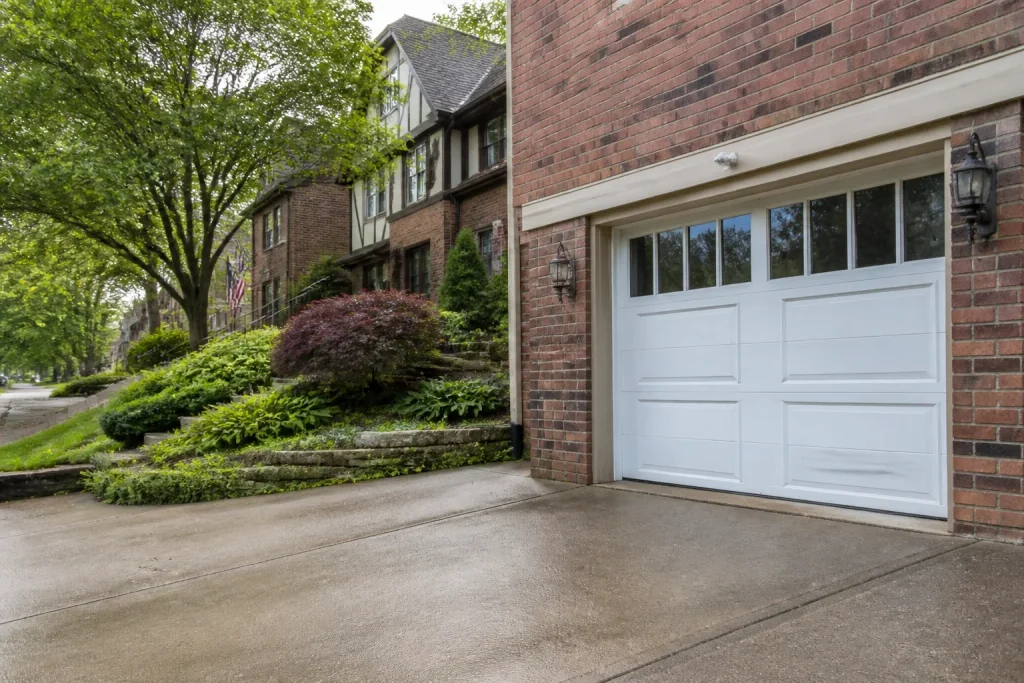
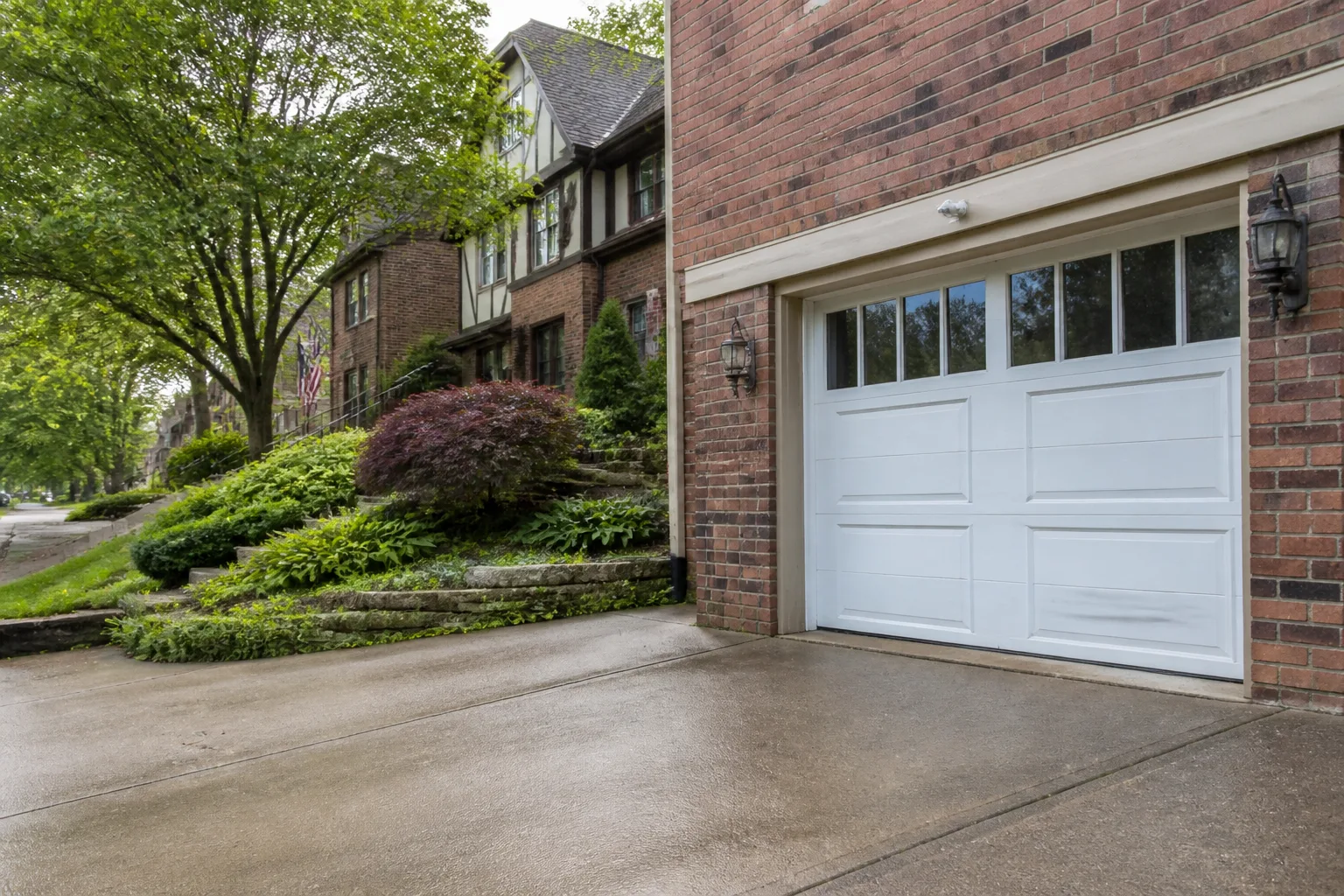
Here’s what the repair-only crowd misses: a garage door is one of the most visible elements of a College Hill home’s exterior. On a street where mature trees, brick facades, and well-kept front walks do most of the talking, a dented, faded, or misaligned garage door is the one detail that undoes the rest of the picture at a glance.
A replacement isn’t only a functional purchase – it’s a curb-appeal investment that carries into resale. The ROI math works like this:
- Doors in visible disrepair (cracked panels, sagging sections) read as deferred maintenance to buyers, who tend to discount accordingly.
- A door that’s mechanically sound but cosmetically tired is often the middle case – a fresh finish or a resurfacing may be enough.
- A door that’s failing both mechanically and cosmetically is the textbook replacement case, especially when the style on the house dates the front elevation.
We’re not going to tell you a new door “pays for itself” – that’s a marketing line. What we will say is that when you’re already facing a four-figure repair, the incremental difference between repair and replacement buys you a visible upgrade at the same time. That’s a different value proposition than a repair that leaves the door looking exactly as it did before.
Why the Opener’s Age Should Be Evaluated Separately
This is the piece most homeowners skip, and it’s the one that changes the decision most often. The door and the opener age on completely different clocks. The door’s springs and panels might be 12 years old while the opener was replaced 3 years ago – or the reverse, where the door is fine but a tired opener is limping along on borrowed time.
That mismatch matters because an opener replacement can be done independently of the door. If your door is healthy but your opener is grinding, dropping its signal, or refusing to reverse, that’s a standalone opener problem – not a reason to replace the whole system. A Craftsman or LiftMaster unit that’s seen better days is a straight swap, and the door stays right where it is.
Where it gets interesting is when both are aging at the same time. If you’re looking at spring repair AND an opener that’s already had a failure, you’re stacking repair costs against a system where everything is nearing end of life. That’s when we start walking a College Hill homeowner through the replace conversation, because the cumulative repair cost is telling the real story. A Raynor or Wayne Dalton door that’s mechanically sound is worth keeping – but only if the surrounding system holds together.
The Damage Types That Make Repair Irrational Regardless of Age
Some damage just doesn’t have a sensible repair path. Age is irrelevant – a cracked structural panel on a 6-year-old door is still a replace-or-reface-now problem, because no amount of adjustment fixes a panel that’s structurally compromised. Here are the conditions where we tell homeowners the repair math simply doesn’t work:
- Cracked structural panels. Panels aren’t just skin – they carry the door’s weight and shape. Once a section cracks, patching it is cosmetic, not structural.
- Warped door sections. Heat, moisture, and time can twist panels out of true. A warped section can’t be tuned back; it has to be replaced, which usually means matching a piece that may be discontinued.
- Corroded torsion bar. The bar is the backbone of a torsion system. If it’s rusting through, you’re not repairing – you’re reconstructing.
- Multiple simultaneous failures. Springs, cables, and panels all failing at once isn’t a repair list – it’s a rebuild in pieces.
- Repeated door-not-flat or tracking failures. If the door keeps coming out of alignment despite adjustments, the panels or track have likely deformed permanently.
When you see any of these, the honest answer is a replacement conversation, and a repair quote is just a delay that costs money twice. Call (866) 401-7447 to have the situation assessed before you spend on a repair that won’t hold.
Comparing a Repair Quote and a Replace Quote on the Same Terms
Most homeowners compare these two numbers badly because the two quotes aren’t itemized the same way. A repair quote tends to be a single line for labor and parts; a replacement quote is often bundled with installation and disposal. If you compare them at face value, you’re not comparing the same work.
Ask for the repair quote to show each component explicitly – springs, cables, rollers, hinges, opener. Ask for the replace quote to show the door, the removal and disposal of the old door, the installation labor, and any hardware that isn’t included. Then line them up in two columns:
- Repair side: what’s actually being fixed, and what’s left untouched that will likely fail next.
- Replace side: door, disposal, installation, new springs, new rollers, new track if included. Note whether the opener is carried over or replaced.
The comparison that matters is not “repair total vs replace total.” It’s “repair total plus the cost of the next failure it doesn’t address” vs “replace total with a full reset on every component.” When you see it that way, the honest answer usually surfaces fast. Our team is happy to write both quotes on the same terms so the decision is easy to make. This is also where garage door repair can turn into a replacement conversation naturally, without a second company stepping in.
When to Call a Pro (And When It’s Actually Safe to Wait)
Some issues are safe to watch. A door that’s slightly noisy, a roller that’s squeaking, or an opener that’s pairing oddly are candidates for a scheduled visit rather than an emergency call. Others need professional eyes right away – and we mean today, not “sometime this week.” Call a pro immediately if:
- You hear a loud snap and the door won’t lift – that’s typically a spring, and springs are the most dangerous part of the garage door system. Never try to lift a door with a broken spring or reach for the torsion hardware yourself; the stored tension in a torsion system can injure even experienced technicians when handled wrong.
- The door is crooked in its track, or a cable is hanging loose.
- The opener runs but the door doesn’t move, or the door reverses unpredictably.
- Any panel has cracked or the door has visibly warped.
For those, call (866) 401-7447. We answer 24/7, and we offer fast dispatch from 7am to 7pm, Sunday through Friday. If a call comes in outside dispatch hours, we book it into the next opening.
Related services in College Hill: garage door opener repair for the unit that’s misbehaving, and garage door installation if the verdict is replacement.
The Bottom Line
The repair-or-replace decision isn’t about age – it’s about which path delivers more months of reliable service per dollar spent. Use the component-by-component framework, not a flat 50% rule. Add curb appeal when the door is visibly worn on a College Hill street. Judge the opener on its own clock. And treat cracked panels, warped sections, and a corroded torsion bar as automatic replacement signals regardless of door age.
Our technicians have up to 14 years of experience, and we work on equipment from LiftMaster, Chamberlain, Genie, Clopay, Amarr, Wayne Dalton, Craftsman, and Raynor. That means the same team that diagnoses your repair can quote your replacement honestly – no second call, no second company. The written estimate sets the final price, and the price is agreed before any work starts.
If you’re in College Hill and need help deciding, Garage Door Repair College Hill offers free estimates – call (866) 401-7447. We answer 24/7. Fast dispatch from 7am to 7pm, Sunday through Friday.
Frequently Asked Questions
Start with a component-by-component check, not the door’s age. If one or two parts are failing and the panels and torsion bar are sound, repair is almost always the better financial call. If you’re looking at cracked structural panels, warped sections, a corroded torsion bar, or several failures at once, replacement is the more sensible path. Call (866) 401-7447 for a free estimate – we’ll walk you through both options.
Not reliably. The 50% rule ignores how much service life each repair buys you. A better test is cost per month of added service life – divide each repair cost by the months that component will last after fixing. Compare that to the monthly cost of a new door spread over its expected life. When the repair side climbs above the replacement side, that’s your answer. Call (866) 401-7447 to get both numbers on the same terms.
No. The opener ages on a separate clock from the door. If the door’s panels, springs, and torsion bar are healthy and the opener is the only failing piece, an opener repair or replacement is a standalone job. LiftMaster, Chamberlain, Genie, and Craftsman units are all common in College Hill, and we handle all four. Call (866) 401-7447 – estimates are free.
No. The written estimate sets the final price, and we quote the full scope before any work starts. If we discover something during the job that genuinely wasn’t visible on the initial inspection, we stop and get your approval before continuing – we don’t surprise you with the invoice. Call (866) 401-7447 for a free estimate.
Written by the team at Garage Door Repair College Hill.
Need Garage Door Help?
Call Garage Door Repair College Hill - the local pro we connect you with is licensed and insured, here with fast help in College Hill.
(866) 401-7447